Cold calls and cold email in Singapore: what the rules allow
The Do Not Call Registry, the Spam Control Act and the PDPA each cover something different. Here's what a sales team can and can't do, channel by channel.
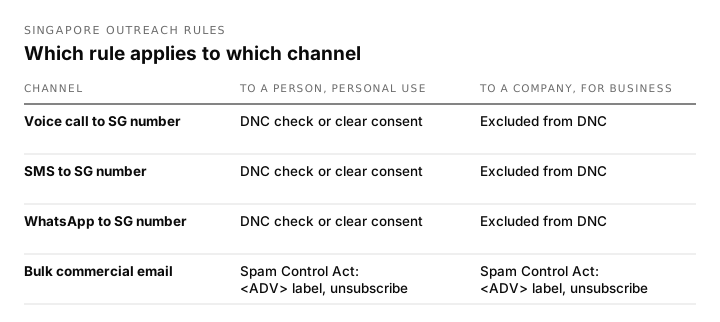
Yes, you can cold call and email companies in Singapore, because marketing aimed at a business sits outside the Do Not Call rules. Marketing to individuals on Singapore numbers needs a registry check or clear consent.
If you're a sales director building an outbound list, that one sentence hides most of the risk. Three sets of rules apply, they cover different channels, and the line between a company and a person is thinner than most teams assume. We went through the PDPC's guidance and the Spam Control Act so you can see where each one bites.
What does the Do Not Call Registry cover?
The registry covers marketing messages sent to Singapore telephone numbers, by voice call, text or fax. The PDPC calls these specified messages, and a message counts if any part of it has a marketing purpose. A delivery update with a discount code is a specified message.
It reaches chat apps too. The PDPC's advisory guidelines say the rules apply to data applications such as WhatsApp, iMessage or Viber that use a Singapore telephone number. So a sales rep blasting offers from a phone is inside the rules, and a WhatsApp sales process has to allow for that.
Before sending, you must check the number against the registry within the previous 21 days, unless you hold clear and unambiguous consent. Consent needs a positive action, such as ticking a box that names the messages. A line buried in your terms won't do.
When does the business exclusion apply?
The exclusion covers messages sent to an organisation for that organisation's purposes. The PDPC's own example is company A marketing its goods or services to company B, for the purposes of company B.
What decides it is the offer. Selling a packaging line to a factory's operations manager is excluded. Selling that same manager a personal insurance plan on the same number isn't, because the PDPC says the rules apply when a message also markets something for the recipient's personal use.
A mobile number is the grey area. PDPC's guide gives an office line as its example of an organisation's contact details, and plenty of Singapore buyers only list a mobile. Our advice is to treat a personal-looking mobile with no business context as a number you check, since a registry check is cheap and a complaint isn't.
Four situations come up often. Here's how we read them.
- Calling a facilities manager on the office line about a service contract for the building: a company offer to a company line, so it's excluded.
- Sending a WhatsApp to a factory owner's mobile about company equipment: excluded if the offer is for the business, but it's the grey area, so we'd run the number through the registry anyway.
- Texting someone who bought from you once, two years ago: PDPC says a one-off transaction isn't an ongoing relationship, so the check applies.
- Emailing the same offer to 150 procurement managers in one day: that's over 100 in 24 hours, so the Spam Control Act conditions below apply.
Is cold email legal in Singapore?
Yes, with conditions. Email sits outside the Do Not Call rules and falls under the Spam Control Act 2007. The Act's labelling and unsubscribe rules apply to unsolicited commercial email sent in bulk, and we couldn't find a business exclusion like the one in the DNC rules. Bulk means more than any of these, with the same or similar subject matter:
- 100 messages in 24 hours.
- 1,000 messages in 30 days.
- 10,000 messages in a year.
Over that line, each message needs four things: an unsubscribe option, the letters <ADV> before the subject line, an honest subject and headers, and a working email address or phone number for the sender. Unsubscribe requests must be honoured within 10 business days.
One opinion here. A subject line starting with <ADV> rarely gets opened, so the better answer is to stay well under the thresholds. Send fewer, better emails to people you've actually researched. That's also what gets replies. If you want the wider method, see how we approach outreach and prospecting.
Can you use a business card or a LinkedIn profile?
Often, yes. The PDPA's data protection rules don't apply to business contact information, which the Act defines as a person's name, title, business phone, address, email or fax, not provided solely for personal purposes. Organisations don't need consent to collect, use or disclose it.
The purpose matters, though. Someone who hands over a card at a trade show has given you business contact information. The same details used to sell them something personal are a different matter under the DNC rules.
Scraping is where teams get careless. The PDPA bans sending messages to numbers obtained through address-harvesting software, and bans dictionary attacks or similar automated means of messaging indiscriminately. That ban applies to any message, so calling it business outreach doesn't help.
Existing customers get some room. If someone has an ongoing relationship with you, such as a subscription, membership or account, a message that relates only to that relationship isn't a specified message. Account statements, warranty and recall notices, and changes to the terms all qualify, and none need a registry check.
It stops there. A new product offer to the same customer may not relate to the subject of that relationship, and PDPC says a message with any marketing purpose stays a specified message even if it also carries service content. When the relationship ends, the check comes back.
What should every message include?
For a specified message, the PDPC requires clear information on who sent it and how to contact them, valid for at least 30 days after sending. If someone withdraws consent, stop within 21 days.
Here's the check we'd run before any list goes out:
- Is this offer for the company, or for the person? Remove anything personal.
- Where did each contact come from? Note the source and date.
- Are any numbers likely to be personal? Check them against the registry and keep the result.
- Is the check under 21 days old on the day you send?
- How many emails go out on this subject today, this month and this year?
- Does every message name the sender, with a working way to reply or opt out?
- Who removes opt-outs, and how fast?
We hold our own outbound to the same standard: a real reply address and a suppression list checked before each send.
This is a practical reading of the PDPC's published guidance and the Act as of 6 November 2026, not legal advice. For a large campaign or anything aimed at consumers, have your lawyer look at the plan.
The rules are the floor. Buyers delete bad outreach long before the PDPC ever hears about it.
Questions we get asked
- Is B2B cold calling allowed in Singapore?
- Yes. Marketing messages sent to an organisation for its own business purposes are excluded from the Do Not Call rules. The rules apply again if the message also markets goods or services for the person's personal use.
- Does the Do Not Call Registry apply to WhatsApp?
- Yes, when the app uses a Singapore telephone number. The PDPC's advisory guidelines name WhatsApp, iMessage and Viber as examples of data applications covered by the rules.
- How long is a DNC check valid?
- 21 days. You must check the number against the registry within the 21 days before sending a specified message, unless you hold clear and unambiguous consent.
- How many emails count as bulk under the Spam Control Act?
- More than 100 messages with the same or similar subject matter in 24 hours, more than 1,000 in 30 days, or more than 10,000 in a year.
Want outbound that stays inside the rules and gets replies?
Send a short note about what you're working on. We reply with how we'd approach it, or tell you if we're not the right fit.