Lead generation in Singapore for manufacturers and distributors
Singapore alone is too small to fill most industrial pipelines. Here's where the enquiries are, what they cost by market, and what to fix before you spend.
Manufacturers and distributors in Singapore get more enquiries by fixing the quote path first, buying search for the products that earn the money, then taking what works into the region. Singapore alone rarely has enough buyers.
If you're the marketing manager or regional marketing lead at a company selling equipment, parts or materials, you've probably felt this already. The budget is fine for one market, the targets assume six, and the report that matters is how many enquiries sales actually called.
How many buyers are searching in Singapore?
Fewer than your targets assume. We pulled Google's monthly search figures for common industrial products across five markets on 6 November 2026. "Air compressor" gets 1,600 searches a month in Singapore and 5,400 in Malaysia. Forklift gets 4,400 in Singapore, 18,100 in Malaysia and 60,500 in Indonesia.
The bigger gap is language. In Vietnam, "air compressor" gets 720 searches and "máy nén khí" gets 12,100, nearly 17 times as many. Indonesia's "kompresor angin" also gets 12,100, and Thailand's "ปั๊มลม" gets 9,900.
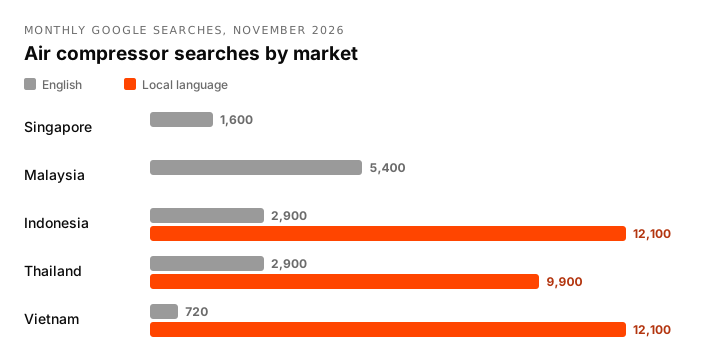
So a regional site in English is close to invisible for most of the people searching in three of those countries. If your distributor in Jakarta or Ho Chi Minh City sells the product, your pages should exist in that language too, one page per product that earns real margin.
Small numbers aren't a reason to skip a term. "Pallet racking singapore" gets 50 searches a month and "industrial valve" gets 50. For a distributor with large orders, a few of those buyers a month can be a good year. Pick terms by what the sale is worth, then check the volume.
What does an enquiry cost in each market?
Clicks are priced very differently across the region. "Air compressor singapore" averages about US$4.10 a click on Google. "Máy nén khí" is about US$0.62, "ปั๊มลม" about US$0.37 and "kompresor angin" about US$0.09. At the sharp end, "forklift supplier singapore" sits near US$21 a click on just 30 searches a month.
Don't read that as a reason to move the budget to Indonesia tomorrow. A cheap click is only cheap if someone on your side can reply in Bahasa on the same day, and if the order is big enough to matter. Our view: run paid search first in the market where you can answer fastest, not the one with the lowest click price.
Then do the sum before you set a budget. Say 4 in 100 visitors enquire. At US$4.10 a click, that's about US$100 an enquiry. Lift it to 6 in 100 with a shorter form and it's about US$68, with no extra ad spend. Those rates are only an illustration, so use your own.
Work back from the order as well. If an order earns S$5,000 in margin and you win 1 in 10 enquiries, each enquiry is worth about S$500 to you. That tells you what you can pay, and it often shows that an expensive click is fine and a cheap one isn't.
Which channels bring industrial enquiries?
Five do most of the work. They differ in speed and in what you get.
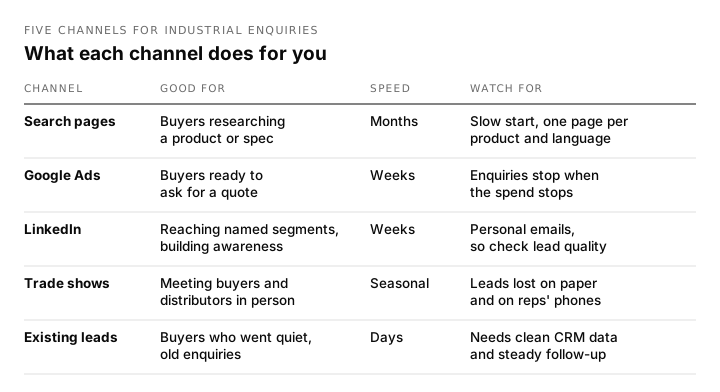
Quality differs as much as speed. In a six-market lead programme for a cable manufacturer, we counted every lead in the client's own CRM and graded it. Marketing brought 553 leads in five months. 96% of audited organic leads and 92% of audited Google Ads leads came from identifiable companies. On LinkedIn, about half of the leads used a corporate email.
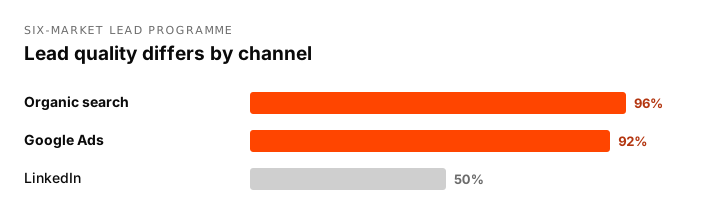
That didn't make LinkedIn a waste. It brought the most leads, and it put the client's name in front of the right segments. It just wasn't a source of sales-ready leads, so we positioned it as the awareness channel. Organic search also took patience: that work began in March 2025, and the leads above were counted from October.
What should you fix before spending more?
The usual instinct is more traffic. More traffic through a leaking path just buys more lost enquiries, so check these first.
- Cut your quote form down to what sales needs: product, quantity, destination and date, and how to reach the buyer.
- Write down what counts as a lead. We use two tests nobody can argue with: a corporate email domain, or an identifiable company.
- Put every lead in the system sales uses. In the case above, LinkedIn leads sat in Campaign Manager and never reached the CRM.
- Name who replies, by market and language, and on which channels. Plenty of buyers in this region will message before they fill in a form, so a WhatsApp enquiry needs an owner too, and it needs to reach the same CRM as the form.
- Keep following up the leads that went quiet. In a long sale, most of them are early, not gone.
Is it different for manufacturers and distributors?
Yes, mostly in what happens after the enquiry arrives.
A manufacturer with a Singapore regional office usually sells through distributors, so a lead from Surabaya or Penang has to go somewhere. Agree the rule before the campaign starts: who gets which market, how fast they reply, and what they report back after 30 days. Without it, your best leads die in a partner's inbox and you never find out why.
A distributor's buyer is often comparing stock, lead time and price on a product they've already chosen. So the pages that bring enquiries carry brand names, part numbers and availability, not a story about your history. Check each brand's rules before you bid on its name in Google Ads, because some principals restrict it.
Where should a Singapore company start?
Here's the order we'd use for a company with one marketing person and a regional target.
- Month 1: fix the list above, then choose five products that earn the money and two markets you can answer in.
- Month 2: run Google Ads on exact product terms, with one landing page per product. Treat it as paid research into which terms bring real companies.
- Month 3: write search pages for the terms that brought those companies, in the buyer's language. That work keeps bringing enquiries after the ads stop.
- Then add the region. Most Southeast Asian trade shows run from March to July, so plan 2027 now and hold every show to one rule: every lead in the CRM within 48 hours.
Check the money before you commit. The EDGE Grant supports up to 70% for SMEs on overseas marketing and trade fairs, and that changes what a two-market test costs you.
A cheap click in a language nobody on your team reads isn't a lead. Start with the market you can answer.
Questions we get asked
- What is the best lead generation channel for manufacturers in Singapore?
- For most, search. Google Ads on exact product terms brings enquiries soonest, and search pages bring them for longer. In one six-market programme, both channels produced leads where more than 9 in 10 of those audited came from identifiable companies.
- Is Singapore big enough to generate leads on its own?
- Sometimes, for a high-value product with a clear local buyer. For the common industrial products we measured, search demand was several times larger in Malaysia, Indonesia, Thailand and Vietnam, so a regional plan gives you far more buyers to reach.
- Do we need local language pages for Southeast Asia?
- If you sell in Indonesia, Thailand or Vietnam, yes. For the product we measured, local terms got several times the English searches in all three, and nearly 17 times in Vietnam.
- Can we use cold outreach in Singapore?
- Yes, for a short list of named accounts. Messages to a company's office line sit outside the Do Not Call rules. Personal numbers need a registry check within 21 days of sending, or clear consent.
Selling across the region? Let's find your next enquiries.
Send a short note about what you're working on. We reply with how we'd approach it, or tell you if we're not the right fit.